


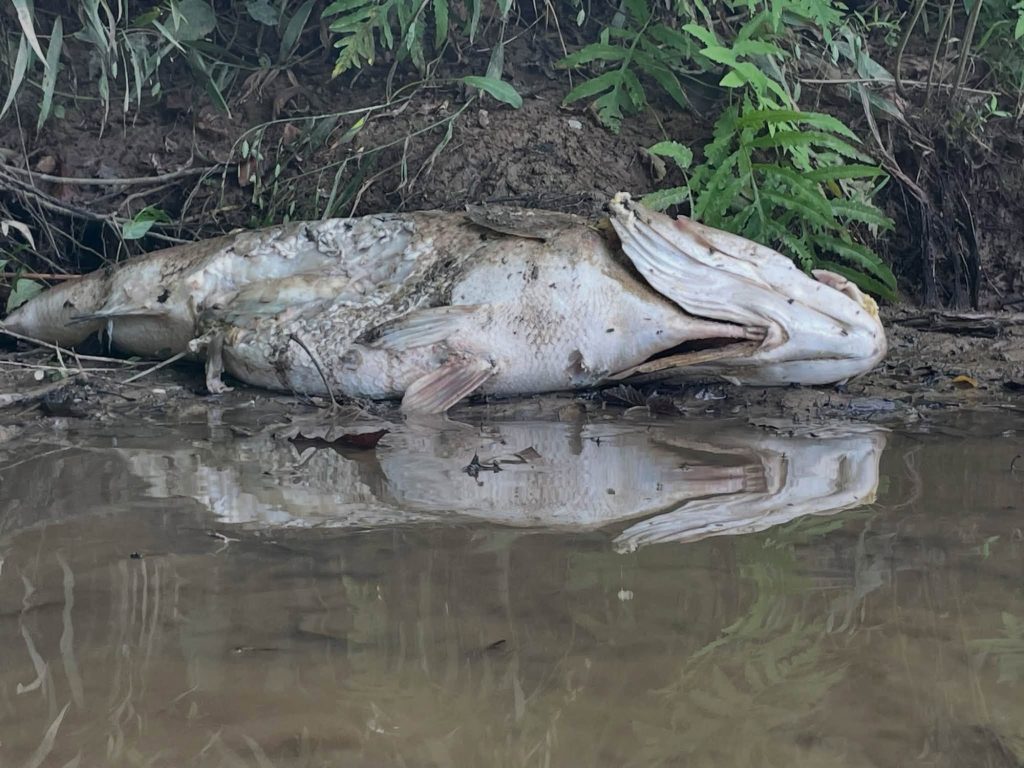
Black Warrior Riverkeeper is investigating a fish kill on the Mulberry Fork after receiving multiple reports over the weekend of August 22-23. On Monday, August 24, Riverkeeper Nelson Brooke took the organization’s patrol boat out and documented dead fish across roughly 17 miles of river, from Cordova upstream to the confluence of the Mulberry and Sipsey forks at Sipsey, and five miles further upstream on the Mulberry Fork.
The water was turbid brown with a green algal bloom and a sheen on the surface, and the smell of decaying fish was significant, according to Black Warrior Riverkeeper. Dead fish observed were mostly blacktail redhorse and freshwater drum, with some river redhorse, striped bass, catfish, and rare southern walleye also found.
“We do not yet know what the root cause of this fish kill was (or when it began), but it was apparently caused by low dissolved oxygen levels in the river,” Black Warrior Riverkeeper said.
The last two fish kills on the Mulberry Fork, in 2016 and 2019, were both traced to pollution from the protein rendering plant in Hanceville - operated by American Proteins in 2016 and by Tyson in 2019, and still operating today under the name River Valley Ingredients. The 2016 incident released roughly 900 gallons of sulfuric acid and stormwater, and the 2019 incident released about 220,000 gallons of chicken rendering wastewater, according to WBRC. The cause of this year’s fish kill has not been determined, and Black Warrior Riverkeeper has not linked it to the Hanceville plant.

Anyone with information, including anonymous tips, is asked to contact Black Warrior Riverkeeper, especially if anyone collected and froze fresh dead fish from the area. Until more is known about the cause, people are encouraged to avoid contact with the water in the affected stretch.
The Alabama Department of Conservation and Natural Resources is the lead agency for investigating fish kills in Alabama and asks to be called first, at (800) 272-4263, or notified through the Outdoor Alabama reporting page. The Alabama Department of Environmental Management is responsible for determining the cause of a fish kill and can be reached through its online complaint form. Reports can also go directly to Black Warrior Riverkeeper.
Riverkeeper staff note that fish swirling erratically or gulping for air at the surface are often the first signs of a fish kill in progress.
Sources: Black Warrior Riverkeeper; WBRC.