

Beginning around 1903, Edward J. Bryan assembled roughly 2,600 acres around Reid’s Gap into Mont Eyrie Orchards - “an apt moniker,” an eyrie being an eagle’s nest, for a fruit operation planted in the hills. It grew into one of the largest peach and apple operations in Alabama, at a time when Blount, DeKalb, and Marshall counties actually led the state in peach acreage, ahead of the now-famous Chilton County. A 1912 visit from the state board of horticulture’s own secretary put a precise number on that scale: 60,000 peach trees, by his own account one of the largest and finest orchards in northern Alabama.
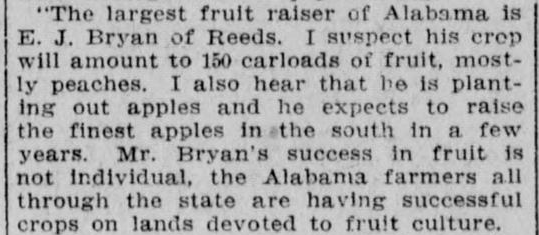
The L&N Railroad didn’t just serve Mont Eyrie - it actively built the orchard’s success. The railroad sold Bryan land from its own holdings in 1905, and in 1912 helped him build a dedicated spur and tramway into the orchard where “all of his trains” would stop for the harvest, sending horticultural experts and extra hands each picking season. By 1914, Bryan had sunk over $155,000 into the operation on the strength of that partnership.
Then the ground shifted. Starting in November 1914, the L&N abandoned the old line through Reid’s Gap for a new route five miles west through Hayden, and by 1918 had pulled up the rails on both sides of Bryan’s orchard entirely - leaving Mont Eyrie stranded with no way to ship fruit to market. Bryan abandoned commercial operations that December.
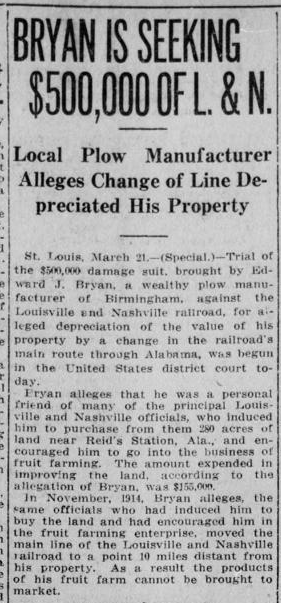
Bryan sued the L&N twice and lost twice. A 1915 breach-of-contract suit reached the U.S. Court of Appeals for the Eighth Circuit, which in 1917 sided with the railroad: it had acted lawfully in relocating its own line, and no binding contract had ever guaranteed Bryan permanent service. Bryan tried again in 1918, this time in Missouri, arguing the L&N had fraudulently concealed its relocation plans while encouraging his investment. The Missouri Supreme Court dismissed that claim too in 1922, ruling that an undisclosed future plan isn’t the kind of false statement fraud law requires - one justice noted a case quite like it had never come before the court.

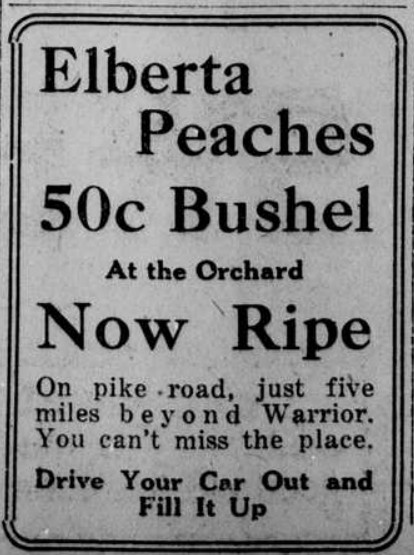
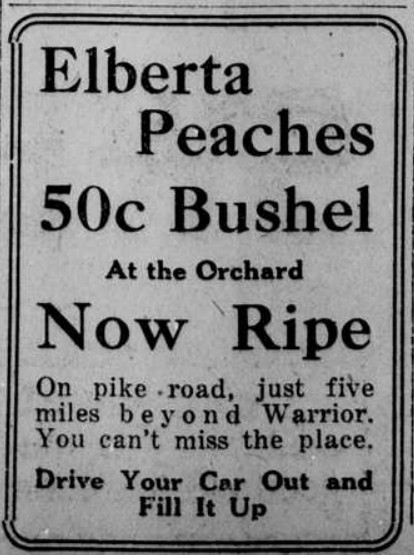
Mont Eyrie never fully recovered, though the land didn’t go entirely fallow: local newspapers later in the 1920s and 1930s advertised “Mont Eyrie Elberta peaches” sold roadside to travelers on the new Bee Line Highway between Warrior and Blount Springs - tree-ripened and, the ads claimed, better than anything shipped in by rail.