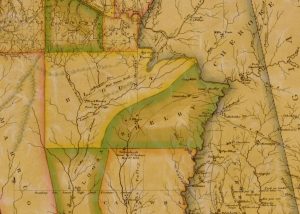


After the Creek War of 1812, Cherokee Colonel Richard Brown established a series of settlements in the valley that came to bear his name - Brown’s Valley, later added to Blount County as “New Blount” following Cherokee removal. Among those he settled was a refugee Creek colony of about two hundred people, governed by John Shannon, also known as John Ogee, a half-blood Creek.
In 1818, Brown traveled to Washington to propose ceding the territory. When word reached the valley, Cherokee families gathered at Gunter’s Landing, ready to emigrate. Brown died at Rogersville before the treaty could be ratified. White settlers moved into the abandoned valley almost immediately.
Stooka - a name meaning “Little Door” - was an anti-cession Cherokee remembered locally for a specific act of bravery: swimming the Tallapoosa River during the Battle of Horseshoe Bend to steal canoes so Cherokee forces could cross. He had been away on a hunting and trapping expedition to Demopolis, selling beaver skins, and returned to find white settlers already living throughout the valley.
Provoked by the son of a Mr. Duke, Stooka struck the young man with a board, killing him. He was captured and held under guard in iron restraints, but broke free the first night and fled. Armed white groups entered the valley demanding vengeance. Cherokee leaders promised to bring him in, and a council sent two unarmed warriors - among them Tooni, Stooka’s own adoptive stepfather, who had raised him.

Tooni found Stooka preparing to leave and join the Creek. Under a false promise of safe escort to Cherokee settlements in the west, Tooni led him to a concealed hut, where hidden warriors shot him through the heart from ambush. His body was carried by canoe to Gunter’s Landing for identification; his own mother’s recognition of the body confirmed who he was.
Powell names his sources for the account directly: Jeremiah Vestal, Alex Gilbreath, and J.H. Henderson - the last of whom had been one of Stooka’s original guards. The story is not a single, isolated telling: Alabama Pioneers has independently published its own account, matching Powell’s on every major point, and adds one further detail - the name of U.S. agent James T. Gaines, present for Stooka’s capture.
Following the cession, those still occupying Brown’s Valley were allowed to retain their land at $1.75 per acre rather than compete in the general public land sale. The valley’s white settlement, and Blount County’s later “New Blount” addition, followed directly from this sequence of events. Warwick Brister, a Methodist preacher active in the same era, held services in what was then called Brister’s Cove - renamed Aurora Valley by the time Powell wrote his history in 1855.
Sources: George Powell, “History of Blount County” (1855); Alabama Pioneers, “Story of the Death of Stooka.”