

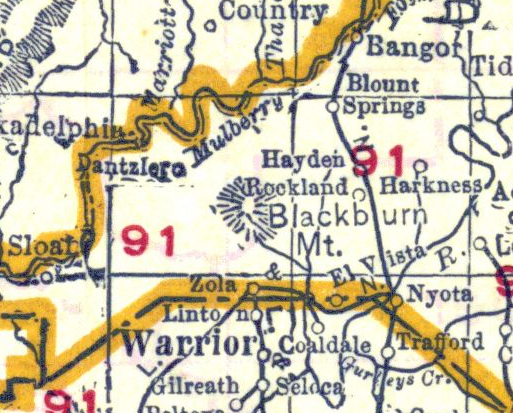
Long before it was Hayden, this was Rockland - settled starting in the 1820s by families whose names still fill the area today: Thomas, Armstrong, Neely, Hayes, Yarbrough, and Merrill. The name Rockland was practical, not poetic: the hilly terrain was scattered with small and medium rocks. The community’s first church, Old Elbethel Methodist, was organized before 1828 - making it older than the state’s rail lines, its county roads, and Rockland’s own eventual name change.
The town’s modern name comes from a real person: Major Hayden, a former U.S. Army officer who moved to Blount County from south Alabama and settled the area before the Civil War. He’s buried on the low ridge that still carries his name today, Hayden Mountain. For decades the mountain bore his name locally while the settlement below it was still known as Rockland.
Rockland’s early civic life ran through the Merrill family’s kitchen: the community’s first post office operated out of Ely Merrill’s home, with his wife Elizabeth serving as postmistress and storing the mail in a corner cupboard that doubled as the town’s informal gathering spot.
Rockland became Hayden in 1914, when the L&N Railroad arrived - the same L&N relocation project that, at the very same moment, was stranding Reid’s Gap and ending Mont Eyrie Orchards five miles to the east. One settlement’s loss was, almost literally, another’s founding: the new line through the renamed town of Hayden is the reason Reid’s Gap was abandoned at all. The Hayden Tunnel opened the following year, in October 1915.

Growth followed the railroad. What had been a single-room log schoolhouse with a dirt floor grew, room by room, into a full twelve-grade school built in the early 1920s on a new site across the tracks. That building didn’t last: fire broke out in the early hours of Saturday, January 16, 1936, discovered around 3 a.m. by Pete Derrick, and by the time volunteer firefighters arrived the stucco building was already lost - along with the library, chemistry lab, athletic equipment, and every school record. The loss was put at $30,000 to $40,000, against $18,000 in insurance on the building and $2,100 on equipment. Classes didn’t stop - two churches and several empty storefronts took in the school’s roughly 350 students and ten teachers starting the very next Monday - while a new brick building went up to replace it, completed in 1939 and still standing today as part of Hayden’s middle school. Old Elbethel was joined by Old Providence Baptist, a Missionary Baptist congregation organized around 1915, and later Church of God and Gethsemane Baptist congregations. The town of Hayden was formally incorporated on May 17, 1949, with N.C. Russell as its first mayor.
Hayden stayed a small town for most of the 20th century - 203 residents in 1950, still under 500 as late as 2010. Then it more than tripled in a decade: the 2020 Census counted 1,342 residents, a 202 percent jump. That’s less a story of new population growth than of the town’s own limits growing - nearby residents opting to join Hayden rather than a wave of new arrivals, the same pattern behind why Hayden’s borders today are a patchwork of enclaves and exclaves rather than one solid area. (Hayden has also produced at least one genuine celebrity: bass angler Gerald Swindle, twice named Bassmaster Angler of the Year.)
Sources: “Hayden School Burned,” the Southern Democrat, January 16, 1936; and Town of Hayden, “Town History”. The 1939 building is still in use today as part of the middle school.