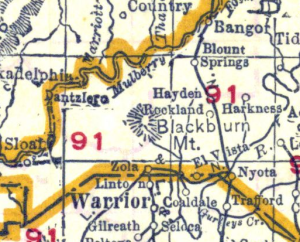


Ricetown is a small community west of Blount Springs, built around a chapel and a cemetery that’s been receiving burials for well over a century. More than 180 people are recorded resting there.
There’s no grand founding story on record for Ricetown the way there is for Hayden or Smoke Rise - no incorporation date, no development corporation, no dedication dinner. What survives instead is four letters to two different county newspapers, spanning twenty years, and one of them settles the question of where the name actually comes from.
1888: a death notice
On November 29, 1888, a Ricetown resident named A. H. Holcomb wrote to the Blount County News-Dispatch in Blountsville - a real paper, founded in 1877 as the Blount Springs News before the county seat moved the operation to Blountsville, and merged into the News-Dispatch in 1887. The letter ran in the December 6, 1888 edition:
“Died, at her residence in this place on the 16th of November, 1888, after a sickness of four months, Mrs. Sallie Rice, aged 80 years. This community has sustained an irreparable loss in the death of Mrs. R., and it is but a just tribute to her memory to say that she was a most admirable, christian lady, who had spent her four score years in doing good. She has gone to her reward! Her trials and tribulations are ended, she sleeps well. May those dear ones, who mourn her departure heed her advice and lead such exemplary lives that they may be reunited with her in heaven.”
Advertisement

Mrs. Rice was 80 in November 1888, which puts her birth around 1808, in the earliest years of white settlement in this part of Alabama.
1898: the name, confirmed
On February 17, 1898, a letter to the same News-Dispatch settled the question this section usually has to leave open. The writer was Mary Gordon Duffee - not an anonymous local correspondent, but an actual documented Alabama author (1844-1920), whose “Sketches of Alabama” later ran in the Birmingham Weekly Iron Age and was published as a real book by the University of Alabama Press. Her own family owned the Duffee House, one of the resort hotels at Blount Springs itself; she wrote from personal knowledge of the area, not secondhand.
Describing the farm country just west of Blount Springs, toward Arkadelphia, she wrote:
“…Further on are the extensive farms of the two brothers, Mr. William and Mr. D. F. Rice; here the settlement is so populous, that it is known as RICETOWN; in this neighborhood reside Mr. Henry Sanders and Mr. Charles Sanders, both large land owners and very substantial citizens.”
Advertisement

That’s the name, explained directly by someone who knew the family: the Rice brothers’ farms were extensive enough, and the surrounding settlement populous enough, that the whole area came to be called Ricetown. Duffee went on at length about D. F. Rice specifically - how his parents had come from East Tennessee before the war and settled the land as pioneers, how he and his brother William served four years for the Confederacy and “returned home to start in life without a dollar,” and how they built the farm back up from nothing through the postwar years. By 1898 D. F. Rice’s place alone ran over three hundred cultivated acres, producing forty bales of cotton and three thousand bushels of corn a year, with a herd good enough that one hog - a three-year-old Poland China - weighed 692 pounds. Duffee called him proof of “what can be accomplished in Blount by a thrifty, industrious class.”
Both Rice farms extended from the highlands down across the Mulberry River. Nearby, she noted, was the plantation of a Mr. Long, a wealthy Walker County lumber manufacturer, with its own gin and grist mill.
1898: a letter from Polly
Five months later, on July 21, 1898, another Ricetown resident - signing only as “Polly” - wrote to the News-Dispatch, opening with a complaint that will sound familiar to anyone who’s ever felt like west county gets overlooked: “As no one has ever honored our little town enough to write up anything from it, I will at least let the good people of old Blount know there is such a place.”
“Health of the people very good. Farmers are bout done work, and crops are looking fine for so much dry weather.
AdvertisementMiss Sallie Rice is staying at Blount Springs drinking sulphur water during the hot days.
J. B. Dial opened school on the 5th… Some of our young people attended the Blount County Teachers’ Institute, held at Swansea July 7, 8, and 9th, and from all reports, had a very enjoyable time… They say they never met nicer people anywhere, and from their talk are thinking of going back right away.
Our protracted meeting will begin next Sunday. Hope we will have a good meeting and add new members to both churches, I say both churches, for we have a M. E. and Baptist Church in the same house and will have our meeting altogether.
One of our noble young men, Charles Sanders, is teaching school at Arkadelphia, we miss him very much.
Advertisement- Polly”

Worth being precise about one thing: the “Miss Sallie Rice” taking the sulphur water cure at Blount Springs in 1898 is not the Mrs. Sallie Rice who died a decade earlier - the 1888 letter is clear she was a married woman, “Mrs.,” while this is a “Miss,” unmarried, and very much alive. Almost certainly a younger relative carrying the same name forward, a common enough practice at the time, but a different person, not the same one. And the “Charles Sanders” here, a young man off teaching school, may or may not be the same Charles Sanders Duffee described five months earlier as an established, substantial landowner - possibly father and son sharing a name, not confirmed either way.
Two real places anchor this letter. Swansea was an actual community - a coal-mining settlement also known as Inland, with its own post office from 1894 to 1908. And Arkadelphia, mentioned by both Duffee and Polly, was in 1880 the second-largest community in all of Blount County, a stagecoach stop on the old Huntsville-to-Tuscaloosa road - though within a couple of years of these letters, a county line shift moved it into Cullman County, where it remains today. The “M. E. and Baptist Church in the same house” Polly mentions is very likely the same building this community’s chapel and Ricetown Chapel Cemetery still take their name from.
1908: a community column
Another ten years on, March 19, 1908, a Ricetown correspondent writing under the name “Clifton” sent a full community column to The Southern Democrat in Oneonta - by then the county’s leading paper, having absorbed the News-Dispatch’s readership when that paper folded in 1903. (The Southern Democrat itself is still around in spirit: it was renamed the Blount Countian in 1989, and runs today as the county paper this site has always meant to complement, not compete with.)

“Bad roads and rainy weather are the leading topics of the day. I wish some of you people in the eastern part of the county would visit this section so as to realize what bad roads are. Ask some of the candidates about our roads.
Every time the dog barks we expect to see a candidate.
Mrs. Rufus Rice is spending a few weeks with her parents at Arkadelphia. Jake Rice is on the sick list. It is thought the infant of S. H. Fry has the measles. Oliver Allbritten came to see his best girl Sunday. Percy Rice and family have moved to our town from Boyles. Glad to have them among us again.
Farmers are getting a late start at their crops - only a few have sown oats.
AdvertisementSome one asked about the writers from the western part of the county. Most of us are so far from the business part of the county, we hardly feel we have any part in it.
Fruit trees will soon be in full bloom. It is feared we will have no fruit this year. Mrs. Rufus Rice is preparing to keep house. Burl Cranswell is the guest of his son, S. P. Cranswell. Misses Mary and Bertie Rice are visiting their sister, Mrs. Edgbert Self. A wagon load of our young people attended church at Sulphur Springs last Sunday. John Rice, Sr., is on the puny list.
I think, like Miss Vessie, that we should make our county paper better. The editor is just as nice as can be to print our letters and we should strive to make each letter more interesting. Let us put new thoughts and new life into our letters. Who will be first to introduce some good subject for all to write on?
- Clifton”
Advertisement
The Rices are everywhere across these four letters, twenty years apart: Mrs. Sallie Rice (d. 1888), William and D. F. Rice building the farms that gave the place its name (1898), Miss Sallie Rice (1898), and Mrs. Rufus Rice, Jake Rice, Percy Rice, John Rice Sr., and Misses Mary and Bertie Rice by 1908 - at least two, probably three generations of one family, exactly matching what Duffee described: a settlement that took its name because the Rices’ farms and family were that extensive.
And that other line carries across the decades too. Polly in 1898: “no one has ever honored our little town enough to write up anything from it.” Clifton in 1908: “we hardly feel we have any part in it.” Different writers, ten years apart, describing the same gap this site exists to close.
What’s still open
Ricetown Cemetery is still there today, still active, on Chapel Road. If either Sallie Rice’s grave is among the recorded burials, if the Rice farms or the Sanders family have descendants still in the area, or if anyone has more on how the community carried on after 1908, that’s exactly the kind of thing this section exists to gather. Get in touch - between what’s in the old newspapers and what’s still remembered locally, there’s more to this story than four letters.
All four clippings were found and shared by Brenda Reeves and Keith Fink. Background on Mary Gordon Duffee from Bhamwiki and the Alabama Authors project; on Arkadelphia from Wikipedia.

Related: Blount Springs - the resort community Ricetown sits near, with its own much longer documented history.