


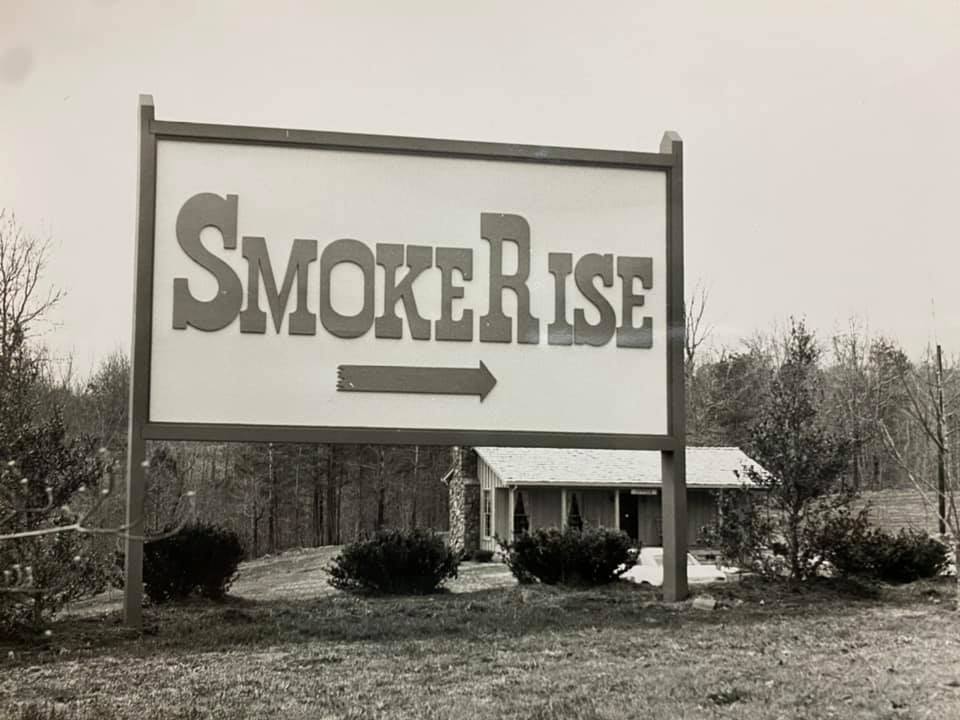
Before it was a subdivision, it was farmland and forest, visible in a 1958 aerial photo of the ridge east of I-65. Logan’s General Store went up that same year on Highway 160, and Zola Missionary Baptist Church followed in 1960. The completion of I-65 from Warrior to Cullman in 1961 is what actually made the land attractive to developers - close enough to Birmingham to commute, rural enough to feel like a retreat.
The Smoke Rise Development Corporation was founded in 1968 by Noel C. Turner, Robert L. Foreman Jr., and Hugh A. Nash, with plans for a full-amenity community: schools, shopping, recreation. Leslie Kelley led construction of the roads and water systems, eventually laying out more than 200 homesites and 14 miles of road across eleven platted sectors between December 1968 and January 1974. A twelfth sector, Scenic Woods, followed in 1986. Protective covenants governing home design and land use were established early - a mechanism still shaping Smoke Rise today.
The platting proceeded sector by sector, recorded in the Development Corporation’s own planning documents:
| Date | Sector | Tracts | Sections |
|---|---|---|---|
| Dec 17, 1968 | Sector One | 170 | 26, 27, 34, 35, 2 |
| Jun 6, 1969 | Sector Two | 137 | 23, 26, 35 |
| Dec 10, 1969 | Sector Three | 73 | 23, 26 |
| Jun 3, 1970 | Sector Four | 118 | 22, 23, 26, 27 |
| Nov 30, 1970 | Sector Five | 147 | 14, 15, 22, 23 |
| Oct 30, 1971 | Sector Six | 109 | 15, 21, 22 |
| Aug 20, 1971 | Sector Nine | 52 | 27 |
| Jan 15, 1973 | Sector Ten | 79 | 21, 22, 28 |
| Dec 10, 1973 | Sector Eleven | 36 | 14 |
| Feb 24, 1986 | Scenic Woods | 8 | SW1/4 of Section 23 |
Sector Seven’s own entry, and a January 3, 1974 entry, are present in the same planning documents but illegible in the surviving copy, and are not reproduced here.

Not everything on the original plan got built. A Smoke Rise Shopping Center - a supermarket, restaurants, a drugstore, built around a rebuilt Logan’s - and a community school, planned for the site Scenic Woods now occupies, both went as far as detailed drawings and renderings before financing difficulties killed them. Kids in Smoke Rise have gone to school in Hayden ever since.
The Smoke Rise Club opened in 1975 with a pool and bathhouse - no pavilion or tennis courts yet. Smoke Rise Baptist Church and Smoke Rise Methodist Church were both established the same year. Welton Carter, of Welton Carter Real Estate (later Blanton-Carter Properties), became the primary lot seller driving the community’s growth from that point forward. Through the 1980s, infrastructure caught up to the original 1968 plan: unpaved roads were paved, water and electric service expanded into easements the original plan had already reserved, and pumping-station improvements addressed water pressure problems on the mountain. On December 19, 1985, I-65 was completed all the way from Warrior to Birmingham, replacing dependence on old US-31 and meaningfully shortening the commute.
By 1990, Smoke Rise had grown to roughly 1,350 residents and gained official Census-designated-place status with that year’s census.
As the community matured, residents recognized a need for formal organization to manage growth and preserve the original standards. Delores Fort was a key advocate, leading to the founding of the Smoke Rise Homeowners Association in 1995, per the Smoke Rise HOA’s own history page. She later entrusted a substantial archive to this newsroom - plat maps, the never-built shopping center plans, Leslie Kelley‘s original materials, even the original stencils for the Smoke Rise entrance sign lettering - which is the direct source of this account.

1995 to today
By 2000, Smoke Rise had grown to roughly 1,750 residents, with median household income at $56,295 and a median home value of $125,000. The community kept growing through the 2000s and reached its high point around 2010 at 1,825 residents, before easing back to 1,661 by the 2020 census - still a close-knit, rural-feeling community even with that dip, according to residents. By the mid-2020s, estimates put the population back up around 1,690, with household income and home values both well above their 2000 levels, reflecting what local accounts describe as a real shift from a middle-class subdivision toward a more affluent community over those two and a half decades.
Local business filled in around the neighborhood over these years: Mee Mee’s on the Corner, Kathy Stodgel’s convenience store, and Jimmy Lee’s Grocery, a community hub for more than 30 years, both served Smoke Rise directly, while a Dollar General and Linda’s Surplus Grocery opened along Highway 160 nearby. Today the Smoke Rise Homeowners Association runs on volunteer-only labor and modest dues, guiding growth under the same protective-covenant system established in the original sectors, and the community marks the year with a Chili/Soup Cook-Off, a community yard sale, a school-supply drive, and an annual Christmas parade.