

Long before Blount Springs was a place people swam or bought a lake-view lot, it was a place people worked a quarry. The same rock face the Sloss family used to rebuild the resort hotel in 1887 had its own separate, purely industrial life - one that still leaves a real, physical mark on the ground today.
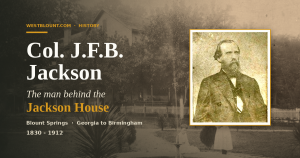
In 1883, Col. J.F.B. Jackson, owner of the Jackson House, was working his own quarries at Blount Springs. In January 1884, a stock company with $10,000 in capital began building two kilns, which the notice called “iron kilns of the most improved kind,” in a quarry right on the railroad and very near the depot. By September the Jackson Lime Company was putting up a barrel factory at Blount Springs to go with the kilns. Quicklime reacts with moisture, so lime was sold and shipped by the barrel, and a works that burned it every day needed its own cooperage.
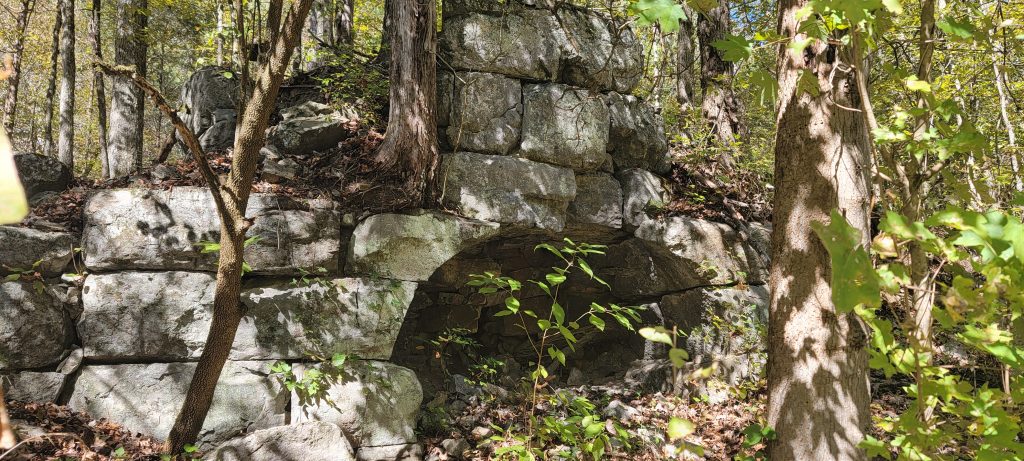
One of the two kilns still stands today. The 1884 notice called them “iron kilns.” What stands now is dressed limestone block with an arched opening, and no iron.
A dedicated rock train ran lime-rock from the quarry to the furnaces in Birmingham, and the work came at a real, human cost. Conductor Bascom Doak was killed when a rock train hit a washout during an unprecedented April 1884 storm that also damaged roads, bridges, and culverts across the district. A year and a half later, on his first trip on the job, brakeman D. N. Paulding was crushed re-coupling cars after a lime train collided with the rear of a Louisville and Nashville through freight in November 1885.

The quarry ran on convict labor. The Huntsville Gazette reported in October 1883 that all the Colbert County convicts had been hired to Col. Jackson of Blount Springs to work in his quarries. An 1885 report from Alabama’s state convict inspectors lists Blount Springs alongside Pratt Mines and a plantation, describing convicts at Blount Springs as “well fed, clothed, and are in good health.” Convict leasing - the state practice of leasing prisoners to private companies for labor - was common in Alabama quarry and mining operations of this era.
Jackson sold out in 1886. The Montgomery Advertiser’s Birmingham letter announced that “Messrs. Fred and Mac Sloss have purchased of Colonel J. F. B. Jackson Blount Springs hotel, quarry and all, including the 1,800 acres of land surrounding.” The Sloss brothers were connected to the Sloss Furnaces in Birmingham, today a National Historic Landmark. The kilns went up under Jackson, two years before the Slosses came.
Convicts were still working the Blount Springs quarries under the Slosses in December 1886, when a newspaper carried the story of Henry Estes, a white convict serving a sixty-day sentence. On the last day of his sentence, knowing he would be taken to Jefferson County to stand trial for horse stealing, he slipped away along the quarry face and ran over the mountain with six bloodhounds on his trail, until the dogs found him up a tree.
Mrs. J. B. Reid’s 1913 account in the Birmingham Age-Herald says the Slosses bought the property from Jackson and “for several years operated the ‘rock quarry’ on the mountain side near the hotel,” and that the work “brought in many new people, both black and white.”

Related: Blount Springs, the resort itself, and Col. J.F.B. Jackson: The Man Behind the Jackson House, on the ownership chain that ran the property alongside this quarry.
Sources: Memphis Daily Appeal, various issues 1884-1885 (lime-kiln notice, January 8, 1884; barrel-factory notice naming the Jackson Lime Company, September 18, 1884; rock-train wreck, dated “Birmingham, April 15” per the clipping, 1884; lime-train collision, November 29, 1885); the Huntsville Gazette (Huntsville, Ala.), October 6, 1883 (convicts hired to Col. Jackson); the Iowa Plain Dealer (New Oregon, Howard County, Iowa), December 23, 1886 (Henry Estes); the Montgomery Advertiser, February 29, 1912, reprinting its March 1, 1886 issue (Sloss purchase from Jackson); the Birmingham Age-Herald, August 3, 1913 (account by Mrs. J. B. Reid); and a contemporary report of Alabama’s state convict inspectors, 1885, source paper not given on the clipping in hand.