

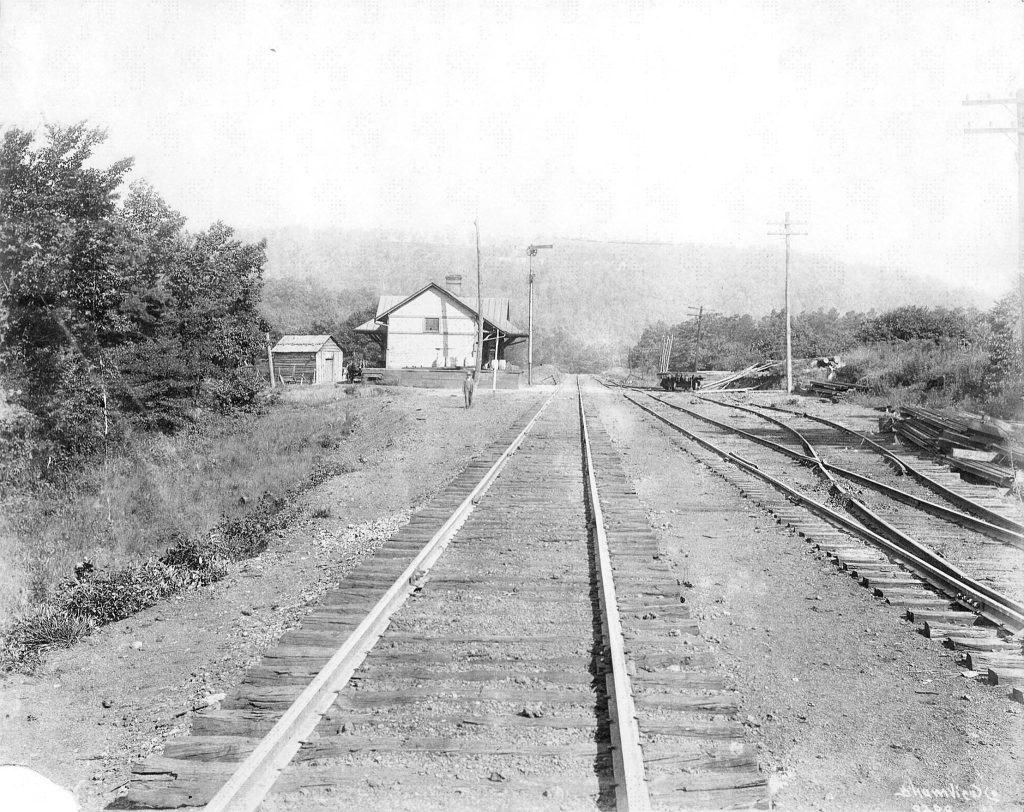
Reid’s Gap was an L&N Railroad depot on the South & North Alabama Railroad line, in the hills of southern Blount County. The South & North line was completed through the gap in 1872, and the station itself first appears on record around 1880.
Who “Reid” actually was still isn’t fully settled - but the name itself is older than it first appeared. An 1859 state engineering survey - John T. Milner’s report to the Governor of Alabama on the route that became this same railroad - names the crossing directly as “Reed’s Gap,” a full thirteen years before the depot existed. That’s now the earliest confirmed mention of the place by name, and it settles one real question even without naming the man: whoever the gap was named for was already a known local landmark before the railroad ever arrived, not someone connected to building the line. (The “Reed” spelling, rather than “Reid,” matches a pattern that shows up repeatedly in period records for this same family - not a different name, just how it was often written.)
Two real, documented candidates for the man himself have turned up, and they don’t appear to be the same person. An 1878 Montgomery Advertiser account (see The Conspiracy to Rob the Train) names Mr. W. C. Reid as “a good citizen of Blount county… living near Reid’s gap.” Separately, George W. Reid (1834-1890) is buried at the real Reid’s Gap Cemetery in what’s now Smoke Rise, a landowning family patriarch in the same area through the station’s founding era; his daughter Lugenia G. Reid married David Lafayette McPherson “at Reid’s Gap, in Blount County, Alabama” on October 24, 1893. No record found yet connects W. C. Reid and George W. Reid as the same person or as relatives - both are real, both are tied to the place by name, and it’s entirely possible the gap was simply named for the wider Reid family rather than one single man. (A third, older Reid turns up in the county’s own history, unconnected to either man as far as anything found so far shows: per George Powell’s 1855 “History of Blount County,” Blount County’s first commercial coal shipment to Mobile was piloted by flatboat in 1827-28 by Levi Reid and James Grindle - real evidence the Reid name was established in this county from its earliest settlement period, whether or not that particular Reid has anything to do with this gap.)
The rest of the cemetery fills the family in further. George’s wife appears to be Mary Louisa Burns Reid (1839-1913), who outlived him by more than two decades. Three generations of Reids and McPhersons are buried around them - and among the later graves is a William Grady Reid (1923-1944), a World War II-era veteran resting directly alongside George’s own children and grandchildren. An earlier, more cursory search had dismissed a same-named Georgia man as an unrelated coincidence; this William Grady Reid, buried in the family’s own cemetery, plainly isn’t that - a real reminder to check a name’s actual resting place before ruling out a connection.

George’s own marital history has a real wrinkle worth naming. His own memorial states he married a Margaret Latham on December 15, 1857, two years before marrying Mary Louisa Burns - though a note on Mary Louisa’s own memorial suggests that earlier license may never have actually been executed. His son Lewis Marion, born in 1858, predates the Mary Louisa marriage and isn’t listed among her own children, making him very likely the son of that first union either way.
A third data point, not conclusive: a 1932 letter names a laborer “Jim Reid” working on a nearby bridge in 1895 - possibly George W. Reid’s son James Harris “Jim” Reid (1872-1919), age-appropriate but not confirmed (see Smith Ford and the Vaughn Bridge).
For three decades it was a working depot - handling lumber, and from around 1903, one of the largest peach and apple operations in Alabama: Edward J. Bryan’s roughly 2,600-acre Mont Eyrie Orchards, with its own railroad-built spur and tramway running directly into the orchard. That ended in 1914-15, when the L&N relocated its main line five miles away through Hayden, stranding both the station and Mont Eyrie on a dead-end track. (See Mont Eyrie Orchards & the Fight With the Railroad for the full story.)
The ground is having a second moment. In June 2026, Rickwood Caverns State Park opened a new access road and entrance that lands near - possibly directly on - the old station site, closing a 110-year loop between the railroad era and the present day.

Sources: Find a Grave, Reid’s Gap Cemetery full burial listing, Smoke Rise, Blount County (George W. Reid memorial ID 140295652, Lugenia G. Reid McPherson memorial ID 124194115, among others) - citing Robin Sterling, Blount County Cemeteries, Vol. 3, pg. 12; and Birmingham Rails, a review and paraphrase of John T. Milner’s 1859 “Report to the Governor of Alabama on the Alabama Central Railroad”.