

It happened on a Thursday night in November 1967, on a bend in the Locust Fork east of Hayden that maps still call Standridge Bend. Somebody set fire to the longest covered bridge in the entire South, and fifty-eight years later, nobody has ever been charged. The bridge fell into the river before morning.
Here’s what we know.
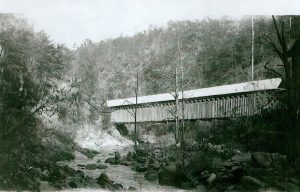
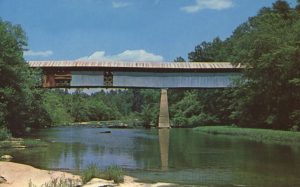
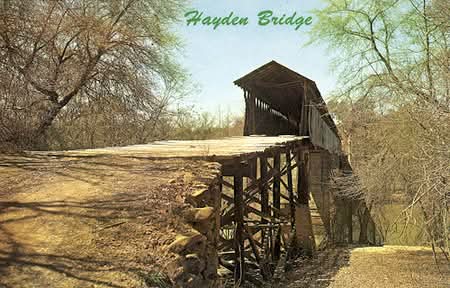
The Standridge Bridge - some called it the Hayden Bridge, depending on who you asked - was built in 1934, the same era of extraordinary bridge-building that gave Blount County Horton Mill, Nectar, and Swann. It crossed the Locust Fork on a Modified Town lattice truss, four spans, 432 feet long, its deck hanging fifty feet above the water.
Fifty feet. Stand on the Horton Mill Bridge sometime and get a feel for what that height means. Then imagine something twice as long.

It was the longest covered bridge in Alabama. The longest in the South. The executive director of the Alabama Historic Commission, Warner Floyd, said at the time it was about five times longer than most covered bridges still standing in the country. He called it irreplaceable.
He was right.
Unlike the county-owned bridges at Swann, Horton Mill, and Nectar, the Standridge Bridge was privately owned - by a man named Curtis Standridge, whose family had farmed that bend of the river for generations. The bridge led to his farm. He maintained it. It was his.
When officers came to his door that November, Curtis Standridge told them he knew of no reason why anyone would have wanted it destroyed.

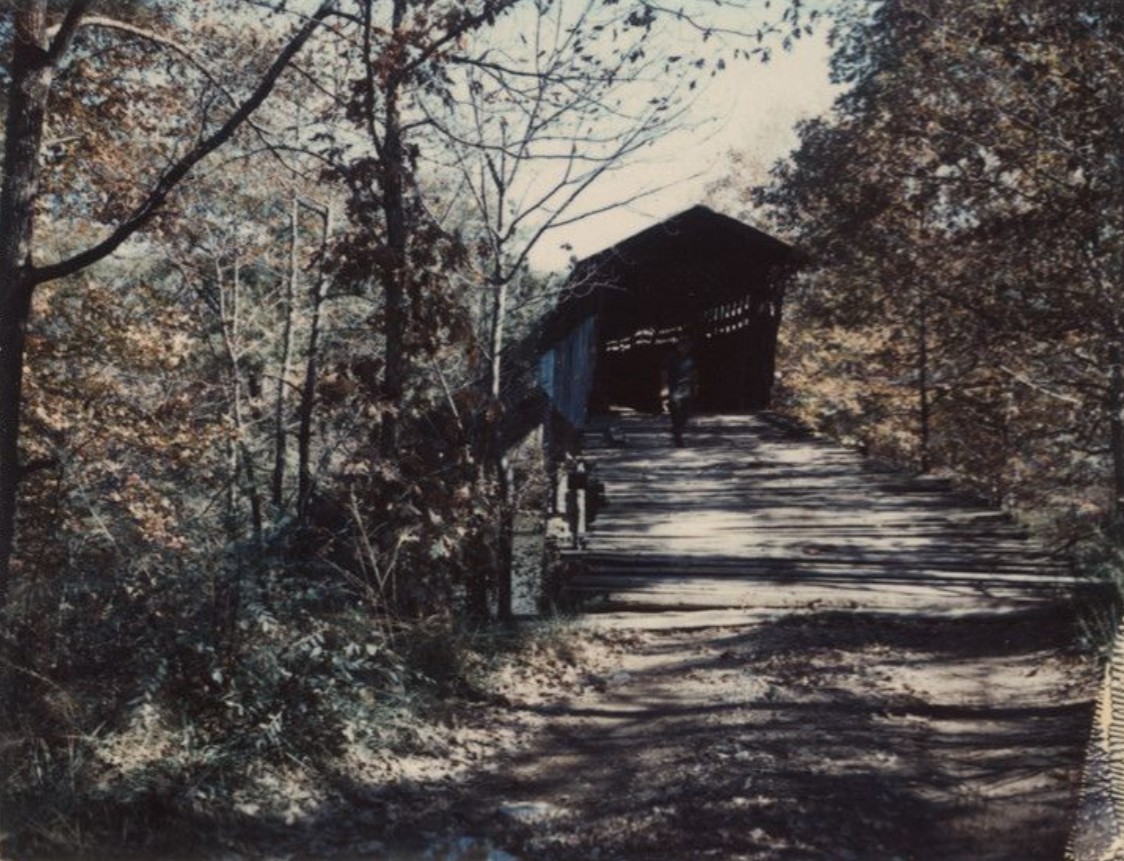
The color photograph above was taken October 25, 1967 - less than a month before the fire. There’s a figure walking through the mouth of the bridge, dappled in afternoon light through the lattice walls. The trees are in full fall color. The road approaching it is unpaved and quiet. Everything about it says: this place has been here a long time and will be here a long time more.
Three weeks later it was gone.
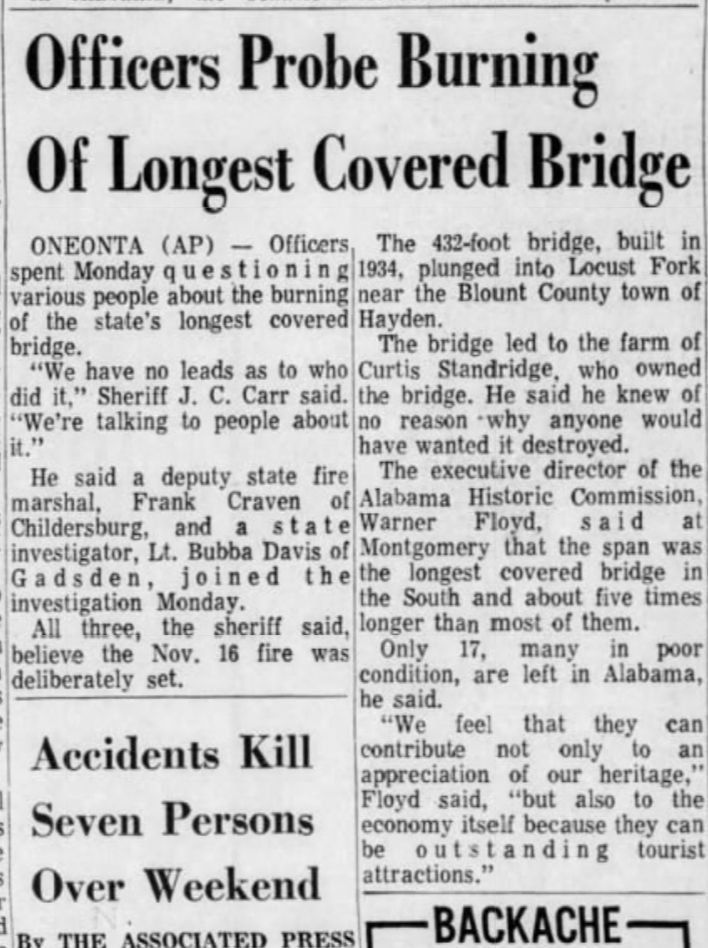
The Associated Press reported it this way: “Officers spent Monday questioning various people about the burning of the state’s longest covered bridge.”
Sheriff J. C. Carr told reporters: “We have no leads as to who did it. We’re talking to people about it.”

A deputy state fire marshal named Frank Craven drove up from Childersburg. A state investigator named Lt. Bubba Davis came over from Gadsden. All three men - the sheriff, the marshal, the investigator - looked at what was left and agreed: the Nov. 16 fire was deliberately set.
Arson. No question.
And then: nothing. No arrests. No charges. No resolution. The case went cold before it was ever really warm. If anyone was ever charged, that story didn’t make it to the historical record we can find.
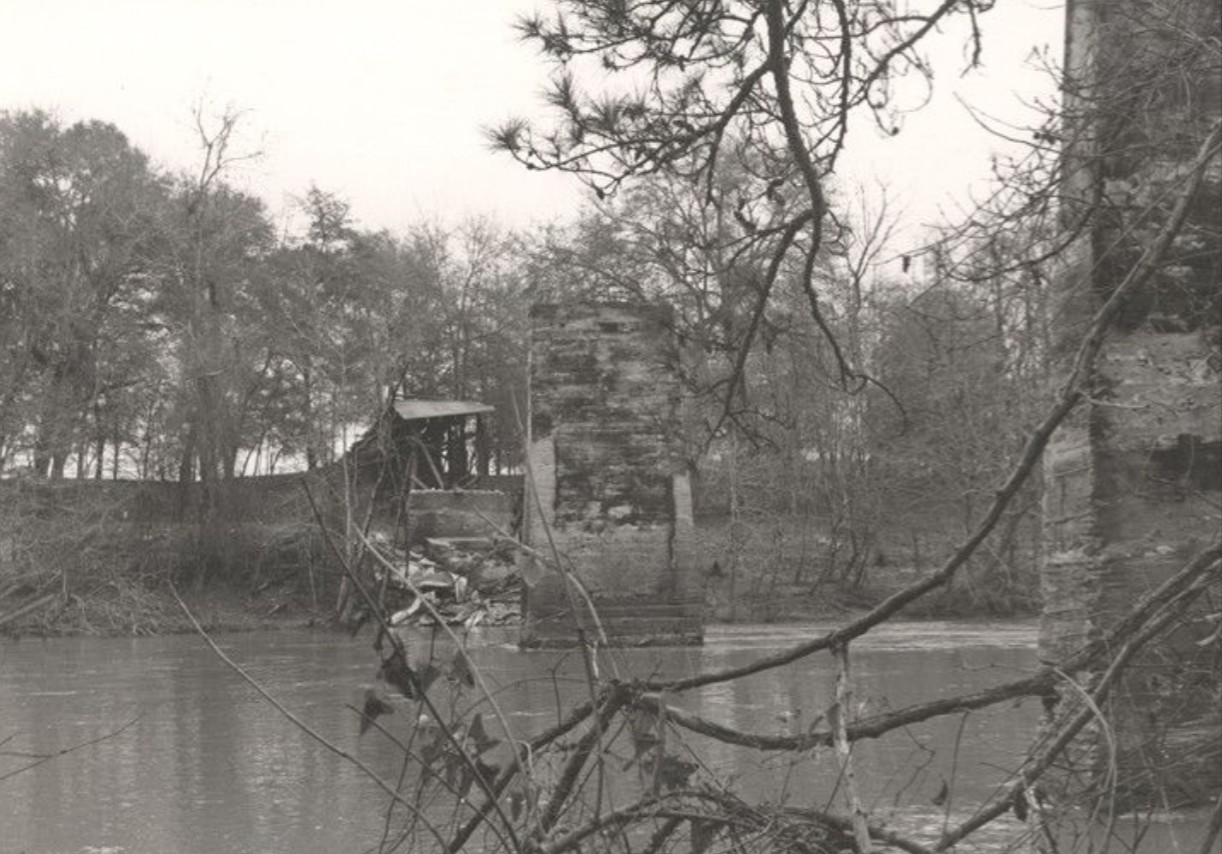
The photograph above was taken in the fire’s immediate aftermath. What you’re looking at are the stone piers, still standing in the Locust Fork like sentinels at a post that no longer exists. Timber debris floats in the water around them. On the bank, the charred skeleton of what was once the covered approach still holds its shape, barely. The trees are bare. The river is flat and gray. Where four hundred and thirty-two feet of wooden bridge stood three weeks before, there is simply nothing.

Those piers are still there today. You can find them at 33.915816, -86.706103. Stone that Blount County hands cut and set in 1934, standing in that river bend for ninety-one years now, outlasting everything that connected them.
Warner Floyd at the Historic Commission told reporters that only seventeen covered bridges remained in Alabama at that point, many in poor condition. He said they could contribute not only to an appreciation of heritage but to the economy - as tourist attractions. He knew. He was trying to save them. He was making the case, publicly, in the press, for why these things mattered.
The Standridge Bridge burned anyway.
Today, Blount County has three covered bridges left. They are magnificent, and we should treasure every plank. But the longest one - the one that would have stopped traffic on any heritage tour in the Southeast - is a pair of stone piers in a river and a bend on a map with a family’s name on it.

Somewhere between October 25 and November 16 of 1967, somebody made a decision.
Sheriff Carr said he had no leads. Lt. Bubba Davis and Frank Craven packed up and went home. The AP moved on to the next story.
Curtis Standridge knew of no reason why anyone would have wanted it destroyed.
If you drove Highway 160 east of Hayden today and pulled over at exactly the right spot, you’d see an old barn standing at the edge of a tree line - county records date it to 1900, older than the bridge itself. The overgrown area in the trees is where the road ran down to the crossing. The road is gone now, reclaimed by decades of Alabama growing season.
But the bend is still there. The piers are still there. The name is still on the map.
And somewhere out there, somebody knows what happened on a Thursday night in November 1967.
They’ve kept that secret for fifty-eight years.
Do you have photographs of the Standridge Bridge, or memories of crossing it? Does your family have any connection to this story? Tell us - this history deserves to be told completely.
Related: Blount County still has three historic covered bridges standing today. Read about Swann Bridge, the longest one still crossing the Locust Fork.