

A second dispatch from the same writer as “An Autumn Day at the Old Home Town”, published in the Birmingham Age-Herald on March 20, 1921 and reprinted here in full. Where the 1915 piece was personal and elegiac, this one is a booster’s case for Blount Springs’ revival - a real accounting of the resort’s assets, its faded grandeur, and its two occupied hillside graves: Mary Gordon Duffee, “the Poetess of the Mountain,” and George D. Fitzhugh, the Virginia-born civil engineer who helped bring the L&N through Blount County.
As spring approaches, our thoughts turn to the country.
“Nor rural sights alone, but rural sounds
Exhilarate the spirit, and restore.
The tone of languid nature.”
Birmingham is peculiarly fortunate in lying so close to the heart of gorgeous mountains. Within just a few miles of her busy, whirling machinery, an hour’s ride over the Louisville and Nashville railroad, is situated a historic spot - Blount Springs. This resort needs no introduction to the south, famous as it is for its beautiful scenery, and its invaluable source of health-restoring waters.

Today Blount Springs stands in a class alone - it is sleeping over an eventful past. If ghosts stalked on this globe, there would be here visions of an interesting yesterday.
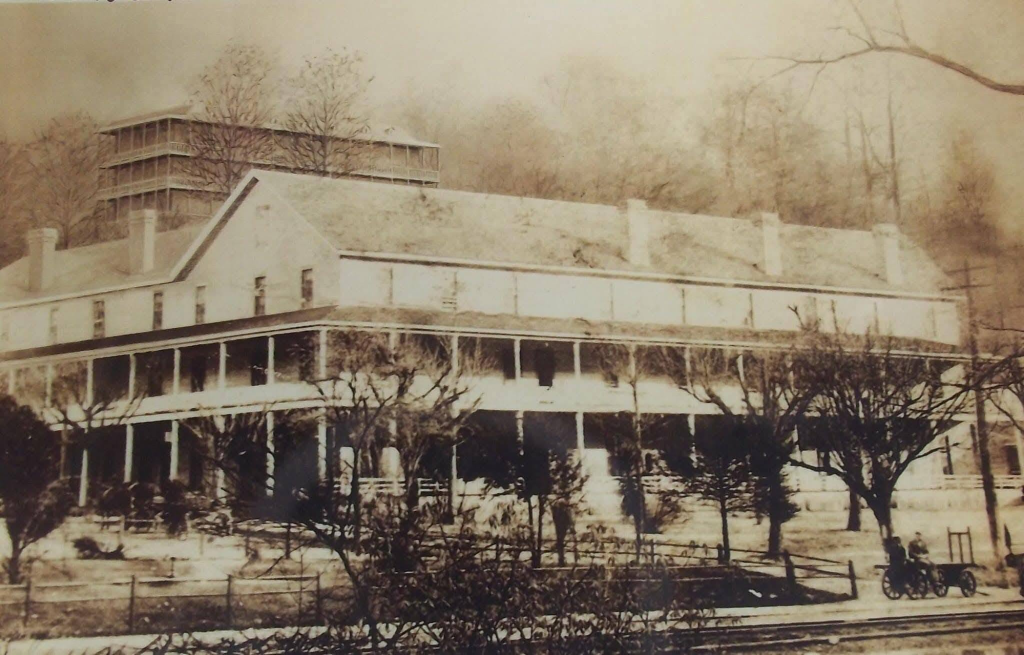
God planted there a beautiful, resourceful country, and man has neglected his duty in not giving it the finishing touch of art and accomplishment. Blount Springs has made much of Alabama’s history, frequented as it was by prominent pleasure seekers and those in search of health. Statesmen and plowman alike have gone over the deep blue bowls of sulphur water and drunk back their health and vigor. If the old pavilion standing there today could talk, it would whisper to you of political gatherings, schemes and plans, even tell of the days of the Ku-Klux Klan, and heart secrets of the grandparents sleeping in Alabama soil now.
This wooden rest place has weathered the storm for more than a half century and now is a wornout monument, while nearby the health-giving waters trickle through the stone and sands, pouring out their medicinal virtues for which generations have rebuilt the bodies of man.
Even though inaccessible for years, in the ’40s and ’50s, the winding, rugged mountain roads were traveled by visitors from several southern states going to and fro.

As the trees begin to don their native green, the woodchuck thumped away on the sturdy oak, the tired and weary, sick and worn turned their faces Blountward. The young and well frolicked, climbed the ledges on horseback or by foot. Picnic parties made the woods resound with laughter and tramping footsteps.
That was yesterday. But man has slept through his opportunity; with wreck and ruin of hotels and buildings. There is nothing of the work of man left except the story of its past. But the future is full of possibilities. The same ideal spot is there, but man has slept through his opportunity, and the future needs the genius of modern good business.
After only an hour’s ride from Birmingham over the Louisville and Nashville, through stone laden mountains, is Blount Springs. The soil is productive; it once was a splendid market of home-made products - even the homespun goods. The mountains and valleys have grown splendid timbers, and the winding streams flow through natural meadows. On the mountain, Duffie’s mountain, we can stand and from one side pass into the Tennessee valley and from the other, looking below, is a ragged mountain side which has been gashed a whole of lime rock, once a well-worked quarry, which gave to Birmingham a part of its mineral wealth, and supplied Sloss furnace with material blended with the red in making iron.
The creek beds are often carpeted with slate rock, and where roads have been dug out of the mountain sides great shelves of slate are secreted by the massive beds of blooming wild ivy and native ferns. The grave of Alabama’s “Poetess of the Mountain,” Miss Mary Gordon Duffee, is there, covered with crude rock and native moss. Hundreds each year climbed the rocky stairway up the mountain to see Miss Duffee and her resting place will ever be of interest. Where she sleeps, curios will be treasured, even the ivy wild violet which blooms there raises its head as if to say in her own words:

“Who dare look at the violet blue
As it peeps through the rocky garth,
And doubt, either me or earth,
The truth, that God, who gave it birth?”
On yonder hill, ‘neath a bended tree, is a vacant place - the grave, which once held the remains of George D. Fitzhugh, and of Fitzhugh Lee. He came, a young man, from Virginia, a civil engineer, and was one of the builders of the North and South railroad, which brought accessibility to Blount Springs and materially aided in placing this Magic City on the map of Alabama. He married a beautiful mountain girl. Their daughter, Mrs. D. T. Talley, lives in this city today. Mr. and Mrs. Fitzhugh sleep together today in Elmwood cemetery, but the vacant grave on the mountainside will ever tell of a beautiful romance of the seventies.
With such a rich history and nature so bountiful, Blount Springs is the natural recreation spot of the south.
The properties include 7,500 acres of land - valley and mountain - with five streams of freestone water, and a natural ice box at the “Randolph cave” - the opportunities for the genius of man and the investment of labor and money are beyond the force of a pen.

Blount should come into its own again, and now that the whole world seems to be looking around to desirable things, she pleads her own cause, at once she is seen. It is an admirable place for a sanitarium - a Moose Heart - or a revival of a summer resort.
At a convenient distance from the noise and bustle of the city, yet accessible to all parts of the country - through trains pass to and from the north and the south twice each day - and so near to Birmingham that it could be called a suburb, especially when the highway leading from the city lacks only a few miles of being completed. Time was when 30 miles meant a day’s jaunt; now, with the automobile and the flying machine, it is just a step across the mountain - a space between work and play.
“By viewing nature, nature’s hand maid, art
Makes mighty things from small beginnings grow.”
By Mrs. J. B. Reid. Originally published in the Birmingham Age-Herald, March 20, 1921.