

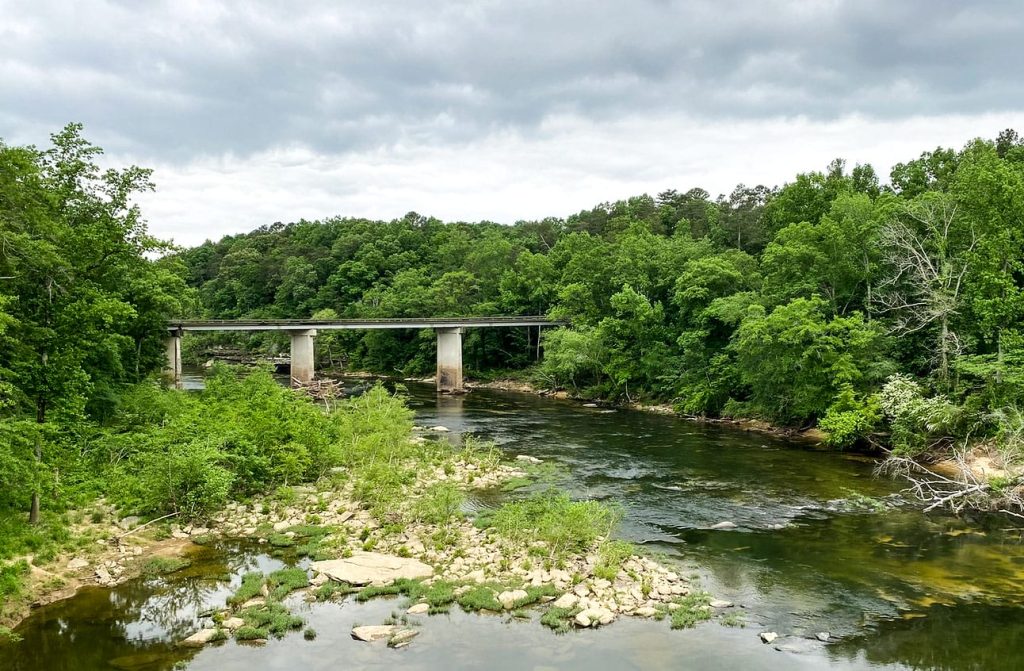
Ask people where the Mulberry Fork of the Black Warrior River got its name and most will guess wild mulberry trees along the bank. A story told in Blount County says the better answer is a silk farm at Blount Springs that never made a yard of silk. The people behind it were the Goffe brothers, and the way their business ended is recorded in a U.S. Supreme Court decision.
The silk story comes from Robin Sterling’s book Tales of Old Blount County, Alabama (revised edition, page 78). Sterling is the North Alabama historian who also compiled the three-volume Blount County, Alabama Cemeteries, built from decades of fieldwork in Blount, Cullman, Winston and Walker counties. The mulberry plantings, the silk building and the river-name connection below are his account. The book is available from Lulu.com and from the Christian Book Store in Cullman. See also his entry in the glossary.
The silk farm, as Sterling tells it
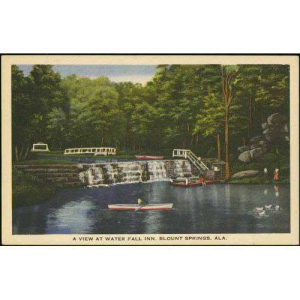
In Sterling’s account, the Goffe brothers came from Connecticut by way of Tuscaloosa in the early boom years after it became the state capital in 1826. One of them, Joseph Monroe “Joe” Goffe, born in 1798, saw the resort potential of the mineral springs at Blount Springs and acquired the property in the early 1830s. He built a sawmill and a gristmill, then used the lumber to put up an elegant three-story, 40-room colonial-style inn, the Goffe House. By 1835 a Goffe was the Blount Springs postmaster.
While developing the property, the Goffes planted 30 acres in mulberry trees and built a 100-by-28-foot building fitted with special shelving. Mulberry leaves are what silkworms eat. It was the start of a silkworm and silk-textile venture, in the years when mulberry-and-silk speculation swept the United States.

Nothing came of the silk. According to Sterling, the name stuck anyway: the Mulberry Fork is named for the failed silk venture, not for any wild stand of trees.
What the court record shows
The brothers’ business is documented in Parish v. Murphree, 13 Howard 92 (1851), decided by the U.S. Supreme Court on appeal from the Northern District of Alabama. The opinion, by Justice McLean, names George Goffe as the owner of the Blount Spring Tract and his brother Joseph M. Goffe as his business partner.
- September 12, 1837: George Goffe and his wife conveyed 640 acres, “including the ‘Blount Spring Tract,’ in Blount County,” to Thomas Williams Jr. for $64,000. Williams gave a deed of trust back to Joseph M. Goffe and George Goffe.
- The same day, George Goffe signed over most of the notes to his wife and four daughters. His New York creditors, the merchants Parish & Co., later sued to set that settlement aside.
- The partnership: “George and J. M. Goffe did business together as merchants,” with several stores “in partnership with his brother.”
- 1839: George’s property within the reach of process was sold. That year he sent “by his brother, ten negroes and other property, worth about ten thousand dollars” to Texas.
- 1840: “George Goffe went to Texas, where he afterwards died.” Twenty-seven judgments had been rendered against him.
- 1851: the Court reversed the lower court and held the 1837 settlement void as a fraud on creditors.
The opinion says nothing about silk or mulberries. It does confirm the outline Sterling gives: two brothers, a merchant partnership, the Panic of 1837, ruin, Texas, and ten enslaved people sent west.
The hotel under a trustee
Period newspapers show what happened to the hotel afterward. In April 1841 a notice signed by Jones C. Lucy, “Trustee, for the parties interested,” announced that the Hotel at Blount Springs would open on May 10 under a manager, Joseph Bondurant, “so favorably known throughout South Alabama,” with a band engaged for the whole season. The notice ran at least nine times in the Southern Argus of Columbus, Mississippi, between April and August 1841. Trustee notices followed in 1842, when board was $40 a month with a physician to advise on the use of the waters, and in 1843, when the notice blamed “the hardness of times, and scarcity of money” for lower rates.

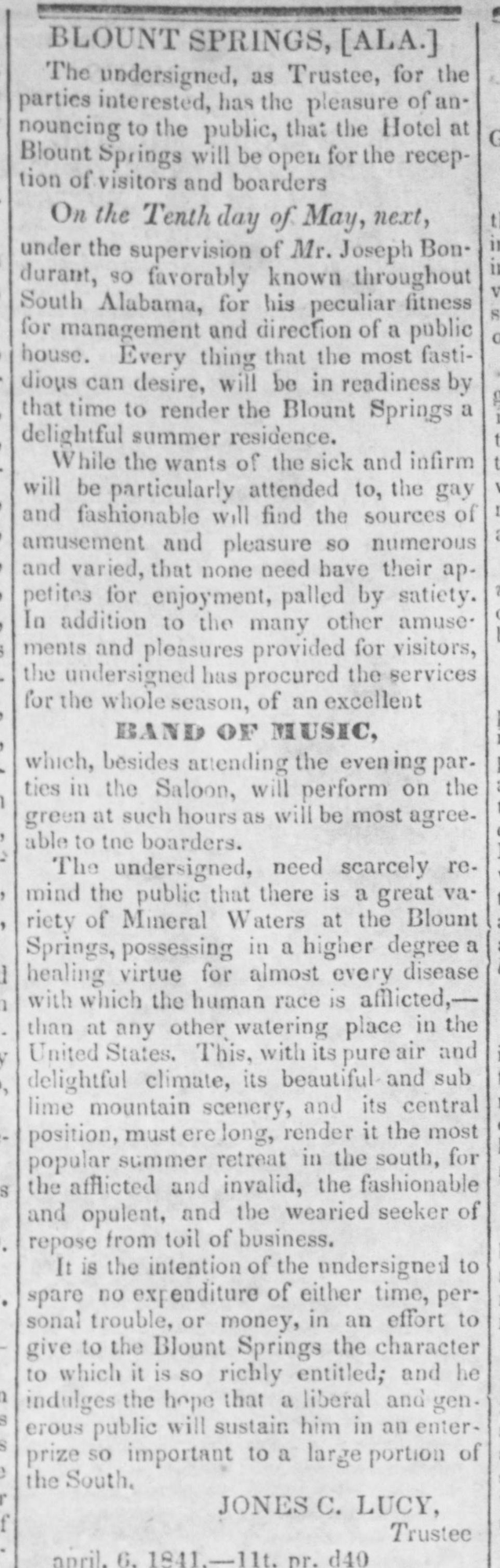
Lucy was still the advertiser the next year. A notice dated April 5, 1844, announced that the Springs would re-open June 1 after improvements “within the last six months,” with a stage running direct from Tuscaloosa to Huntsville by the Springs three times a week. The hotel was being advertised by a trustee, not by an owner, in 1841, 1842, 1843 and 1844.
The 1844 guest register
A hotel guest register headed “Blount Springs 1844” survives from August 1844, with entries for Sunday the 11th and Monday the 12th, the summer after that trustee notice. The guests came from Tuscaloosa (Miss Hopkins), Lowndes County (Wm. B. Scott), Selma (William Morgan), Demopolis (Wm. H. Lyon and family) and Huntsville (T. C. Horton and family), along with John Fowler of Blount County. The Facebook page’s caption calls it the Goffe House register and says the Goffe House remained the main hotel at Blount Springs until the Jackson House went up by the tracks after the railroad was finished in 1872.
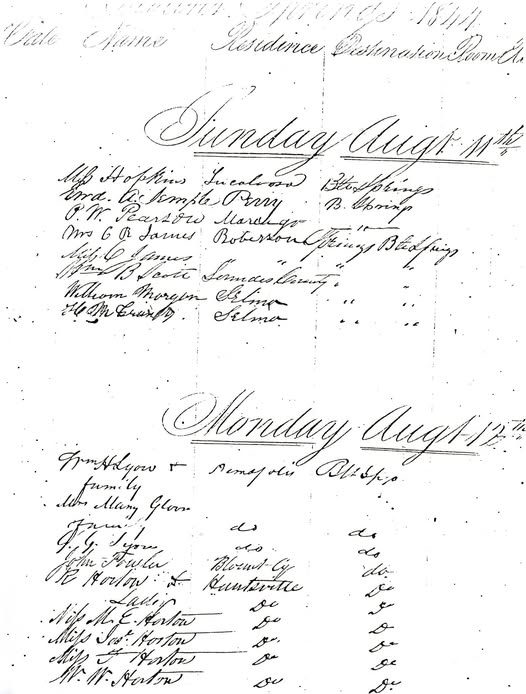
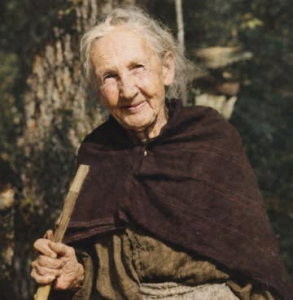
Matthew Duffee later bought the original hotel and renamed it the Duffee House. It burned in 1869. His daughter’s story is told in Mary Gordon Duffee: The Hermit of Duffee’s Mountain.
Other tellings of the silk story
The silk story was told in other places too, and they name George. A 1936 article in the Southern Democrat says that “in the early forties” the property was sold to “a Mr. George Goff, a wealthy New Yorker, who planted Mulberry trees,” that “the river took its name from this project of Mr. Goff,” and that “the silk industry was a failure so was Mr. Goff.” Historian Greg Burden, in a 2019 talk at the Cullman County Public Library reported by the Cullman Tribune, named George Goffe (the article also spells it Goff) as the builder of the Goffe House and said he planted mulberry trees and tried to establish a silk trade.

Mary Gordon Duffee’s 1892 Sketches of Blount County also names George Goffe as the man who built the hotel. She adds a detail about the mill: the sawmill and gristmill were already there, built by Anthony Hogeland and Sam Anderson, and Goffe bought them out. He then tried to build a larger mill below the forks of Mill Creek, but the dam washed out in a flood and he never rebuilt.
The court record settles who owned the Blount Spring Tract and how the Goffes’ business ended. The silk and the mulberries rest on Sterling’s book, the 1936 article and Burden’s talk, and no court record or period newspaper found so far mentions them. If your family papers or courthouse records can add to this, we would like to hear from you.
Further reading: For the full story of the resort, see Greg Burden’s book Blount Springs: Alabama’s Fountain of Youth (Fifth Estate), a history of Blount Springs as a health resort, and follow his Facebook page of the same name.
Sources: Robin Sterling, Tales of Old Blount County, Alabama, revised edition, p. 78 (silk venture, mulberry plantings, river name); Parish v. Murphree, 13 How. 92 (54 U.S. 92), U.S. Supreme Court, December 1851; notices signed Jones C. Lucy, Trustee, Southern Argus, Columbus, Miss., July 27, 1841, June 7, 1842, Democratic Whig, Columbus, Miss., July 13, 1843 and Columbus Whig, May 30, 1844 (Library of Congress, Chronicling America); Greg Burden, “Blount Springs, Alabama’s Fountain of Youth” Facebook page, hotel guest register, August 1844; Southern Democrat (Oneonta), 1936, as reprinted by Alabama Pioneers; Maggie Darnell, “History of Blount Springs: Historian Greg Burden speaks at Cullman County Public Library,” Cullman Tribune, Dec. 7, 2019; Mary Gordon Duffee, Sketches of Blount County (1892). Related: Blount Springs.