

Mary Gordon Duffee was about seventeen in 1861, the year her three older brothers - William Henry, George Gillespie, and James Knox Duffee - joined the Confederate army. James Knox went in as an officer and is remembered on the family’s grave marker with the rank of captain.
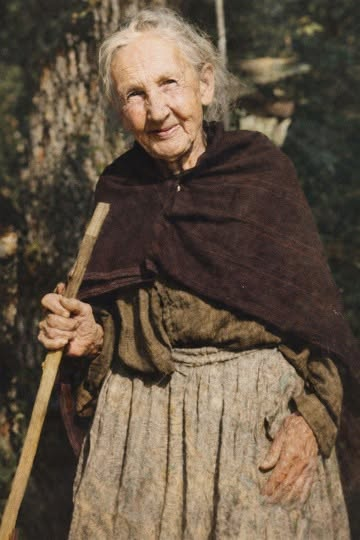
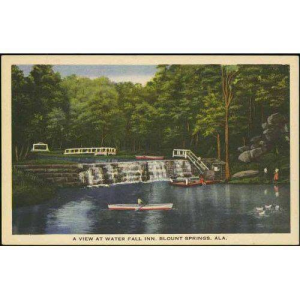
Who actually held the postmaster’s commission at Blount Springs during those years is genuinely unsettled, and this site can’t resolve it cleanly. Family telling has brother James as postmaster in 1861, with a teenaged Mary filling in at the post office while he was away in service. But the published biographical record tells it differently, and isn’t even consistent with itself: an 1889 New York Times account credits Mary herself with the postmistress’s role during the war, a claim repeated in Appleton’s Cyclopedia of American Biography and in James Sulzby’s 1949 Alabama Review article on Blount Springs. A different piece of the family’s own history, already told in Mary Gordon Duffee: The Hermit of Duffee’s Mountain, has their mother Martha serving as postmistress instead, tied to an 1866 census signed “M. A. Gillespie” - very possibly Martha, taking the count of her own community under her maiden name. Three tellings, three different Duffees. More than one could be true at different points across the war and its aftermath, but nothing found so far actually says so - worth reading as an open question, not a settled one.
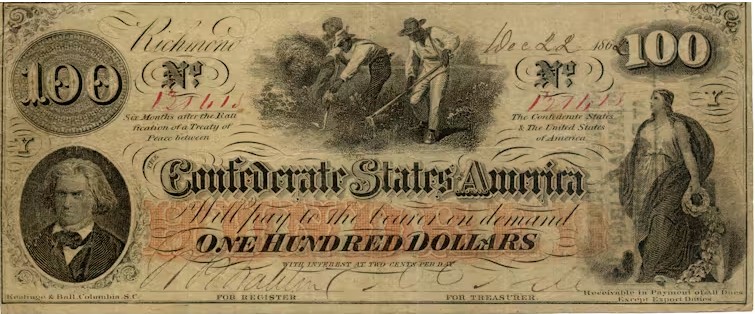
What isn’t in dispute is the story that made her locally famous. In the autumn of 1864, with the Confederacy’s fortunes collapsing and Union cavalry having already raided Blount County twice that year - Streight’s raid in May 1863, Rousseau’s in July 1864 - a package arrived at the Blount Springs post office addressed to a Confederate quartermaster, reportedly attached to a General Morgan’s headquarters near Nashville. How it ended up at Blount Springs instead of continuing on toward Nashville was never explained. Inside was $100,000 in Confederate currency - by a wide margin more money than Duffee had ever seen in one place. A period account of the story, read directly rather than through a later secondhand citation, specifies the addressee as “Quartermaster-general Morgan” - a job title paired with a surname, not simply “a General Morgan.” That makes cavalry commander John Hunt Morgan, killed near Greeneville, Tennessee, on September 4, 1864, considerably less likely to be the man meant here; the Confederacy’s own Quartermaster-General from August 1863 onward was Alexander Robert Lawton, so “Morgan” more likely names a subordinate or regional quartermaster officer serving under him. Exactly which officer isn’t resolved by what’s been checked so far, but the question is narrower than it once was.
Whatever the exact chain of custody, the money reached Duffee, and she spent it not on herself but on her neighbors. Blount County families - wives, widows, and children of soldiers still away or already dead - were going without livestock, food, and clothing after two years of raids from both armies. Duffee used the money to buy cattle, provisions, and clothing, distributing them through the surrounding countryside until the funds ran out. Confederate currency wasn’t worth much by late 1864, so the sum likely stretched further as relief goods than a flat $100,000 figure suggests, but by every account she kept none of it for herself.

The Confederate government traced the missing package and sent a Louisiana cavalry regiment to arrest her - by then, according to family telling, popular enough locally that the arresting officers worried about a rescue attempt, and moved her to Mobile under heavy guard. The Duffee family had real standing there: her father Matthew kept a winter hotel in Mobile, and her brother George worked in the city as a bookkeeper. Family friends with real influence took up her case, and the appeal reportedly reached President Jefferson Davis directly. Davis ordered her released without trial, and she returned to Blount Springs.
This version of events - read directly from a July 1, 1889 Indianapolis Journal wire piece headlined “A Poet Plunderer,” almost certainly the same underlying story the New York Times carried that same season - confirms the core of it point for point: the $100,000 shipment from Montgomery toward Nashville, the interception, the relief spending, the arrest, the pardon from Davis. Later published sources vary the story’s details from one telling to the next, which is about what you’d expect from a story that was already twenty-five years old, and already local legend, by the time the wire services picked it up.
A 1920 obituary, written by someone who’d known Duffee personally since 1868, tells the story differently in real ways: rather than Confederate currency shipped to a quartermaster, it describes “some mystery surrounding the disappearance of some cotton money” just before the war’s close, with “suspicion rested on men of prominence” - and has Duffee deliberately taking the blame herself to shield those men, rather than spending relief funds on soldiers’ families. No $100,000 figure, no quartermaster, and no Jefferson Davis pardon appear in this telling; the war simply ended before a trial could be held. This site doesn’t treat the two versions as a contest to be settled - the postmaster question above is already an open multiplicity of tellings, and this is a fourth telling of the money story itself, from a source with a genuine claim to closeness. Worth knowing alongside the fuller, earlier-documented 1889 version, not instead of it.
Duffee’s family lived on for years after the war ended. Her father Matthew died in 1878, having lived to see the Duffee House rebuilt and the railroad finally reach Blount Springs after an 1869 fire. Mary Gordon never married; she eventually moved to the family’s home on Duffee’s Mountain and became the subject of her own story on this site - the same writer whose letters also told the origin of Ricetown and part of the history of Blount Springs itself.

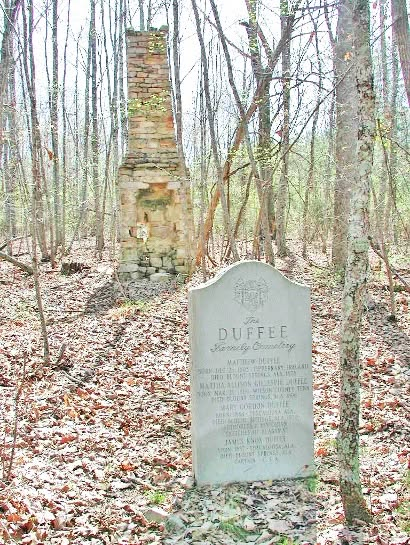
Related: Mary Gordon Duffee: The Hermit of Duffee’s Mountain and Blount Springs.
Sources: New York Times, June 24, 1889 (as cited in the Find a Grave memorial below); Find a Grave memorial for Mary Gordon Duffee; Alabama Authors project, University of Alabama Libraries (citing Appleton’s Cyclopedia of American Biography and James F. Sulzby Jr., “Blount Springs,” Alabama Review II (1949): 163-175); and family photographs and grave-marker documentation of the account; “A Poet Plunderer,” The Indianapolis Journal, July 1, 1889; and Augusta Randolph Reid, “Death of Mary Gordon Duffee Removes a Historic Figure,” Birmingham Age-Herald, August 21, 1920.