

Joseph Franklin Ballenger Jackson - Col. J.F.B. Jackson to everyone who knew him at Blount Springs - was born January 31, 1832, in Franklin County, Georgia, the son of William and Lucy Jackson. He had four brothers who all served the Confederacy: Eppy W. (11th Georgia Infantry, wounded at Second Manassas), Benjamin F. (4th Georgia Cavalry, at Chickamauga), John M. (major, 43rd Georgia Infantry, at Jonesboro), and Thomas A., who died in 1865 of wounds. Jackson himself was wounded three times, the last wound ending his own military service. After the war he represented his county at Georgia’s first postwar constitutional convention.
By his own account he was “almost penniless” at the surrender, and rebuilt through railroad contracting. That work brought him to Birmingham in 1871, where he built more than a hundred miles of the L&N Railroad through Alabama and later served as superintendent of roads for Jefferson County.
Building at Blount Springs
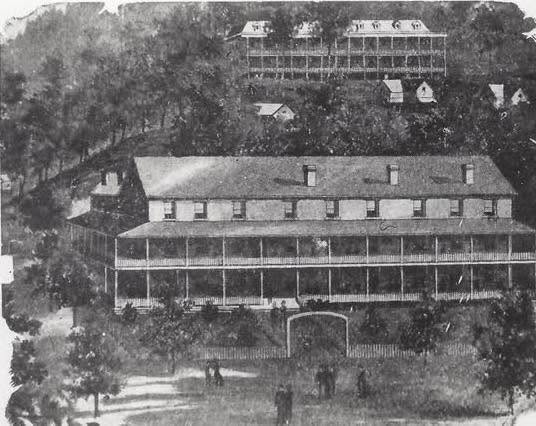
When the South and North Alabama Railroad reached completion, Jackson set his sights on Blount Springs itself. The resort’s earlier hotel, run by Matthew Duffee, had burned in 1869, per the UA Libraries “Alabama Authors” project and the editors of the 1970 annotated edition of Duffee’s own Sketches of Alabama. This same 1881 newspaper profile instead describes it as “burned by a Federal raiding party, near the close of the war” (closer to 1865) - a single source against two more carefully researched ones, so 1869 is treated as the more likely date here, though not certain. Duffee couldn’t rebuild - the property had competing claimants and a clouded title that scared off other buyers - but Jackson made arrangements with the claimants and built what came to be called the “old Jackson House,” a small hotel that opened in 1874 - its opening advertisement, signed by manager W. C. Morrow, promised the hotel would be ready “by the First of June” that year. It became popular enough that demand outstripped the rooms available. By 1880, an advertisement instead names Captain J.D. Towner as proprietor - whether he owned the property outright or operated it under lease by that point isn’t established.
About 1877, Jackson sold a half interest to Henry F. DeBardeleben - already, or soon to be, one of Alabama’s most consequential industrialists, later the driving force behind the Pratt Mines and Alice Furnace in Birmingham. Together they built the larger, more modern “New Jackson House,” which opened in 1878. DeBardeleben sold his interest back to Jackson around 1879 to focus on his mining and furnace ventures. By 1880 the Blount Springs property was assessed at $35,000.

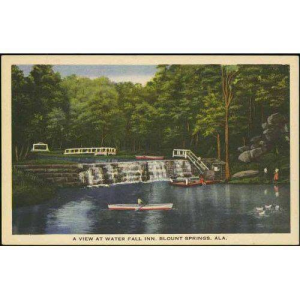
Ownership kept moving after that. By 1880, an advertisement names J. D. Towner as the resort’s proprietor - whether he owned the property outright or operated it under lease isn’t established. In 1887, The Blount Springs Co. - backed by brothers James and Mack Sloss, who also operated the Sloss furnaces in Birmingham - purchased the hotel and surrounding land from Jackson, installing E. F. Denechaud of New Orleans, and by 1889 O. F. Hickle, as on-site managers. A visiting writer that spring confirmed the Sloss brothers were personally driving a rebuild, having seen the actual hotel plans in their Birmingham office before construction began. The company renamed the property the Blount Springs Hotel and invested heavily in improving it - a new two-story building called the Mountain House had already gone up alongside the original Jackson House by 1883 - building the reputation that made Blount Springs one of the best-known resorts in the Southeast. Ownership passed eventually to Walter Melville “Mel” Drennen, who owned the resort from 1900 until fire destroyed it on June 3, 1915, with Albion Benton Green managing it day to day on his behalf.
Jackson wasn’t only building hotels. Around 1877 he tried to get the Blount County seat moved from Blountsville to Blount Springs - and failed. An 1881 profile of him in the Blount County News and Dispatch noted the failure dryly, comparing him to his famous namesake: “lest, like his namesake, the world renowned General ‘Stonewall’ Jackson, he should become a fatalist,” the paper felt obliged to remind him he hadn’t, in fact, succeeded at everything he tried.
At home
The same 1881 profile describes Jackson as reticent with strangers but talkative among friends, a Democrat willing to criticize his own party’s leaders, and an avid fox hunter who kept a pack of hounds. He and his wife lost their only daughter to diphtheria; a few years before 1881, after a relative died of yellow fever in Chattanooga, they adopted the man’s three-year-old son, described as “the light and life of that beautiful cottage on the mountain” - very possibly the same “Summer Home” building behind the hotel already documented on the Blount Springs post. Family genealogical records list a son, Sparks Jackson (1875-1911), whose birth year fits the adopted boy’s age - a plausible match, though not confirmed as the same person.
Jackson married twice: Matilda C. Morris in 1859, and Sallie Hoke of Greenville, South Carolina, in 1867.

Death
Jackson eventually settled permanently in Birmingham. On the night of January 14, 1912, he was struck by a streetcar at Seventh Avenue and Nineteenth Street; he died from the shock the next day, at age 80. The Atlanta Journal called him “one of Birmingham’s oldest and most prominent citizens” and “one of the early industrial leaders of the Birmingham district.” He’s buried at Elmwood Cemetery in Birmingham, alongside his son Sparks and a daughter, Nannie Jackson, who died in 1871 at around age three.
Related: Blount Springs, where Jackson built and ran the resort for over two decades.
Sources: “Traits and Stories of Blount: Noted Characters, Col. J.F.B. Jackson,” The Blount County News and Dispatch, January 20, 1881; Jackson family genealogical record; “Col. J.F.B. Jackson Dead,” The Atlanta Journal, January 15, 1912; and independent confirmation of the DeBardeleben partnership via Encyclopedia of Alabama, “DeBardeleben, Henry”; the Memphis Daily Appeal, various issues 1874-1880 (Jackson House opening ad, May 14, 1874; J. D. Towner ad, June 2, 1880); and Thomas P. Grasty, “A Southern Resort,” The Arkansaw Traveler, May 28, 1887, for the 1887 Sloss/Blount Springs Co. purchase.